Yemen Center for Human Rights Publishes Report Documenting 768 Incidents and 1,060 Casualties During 120 Days of Escalation by the Saudi-led Coalition against Yemen.
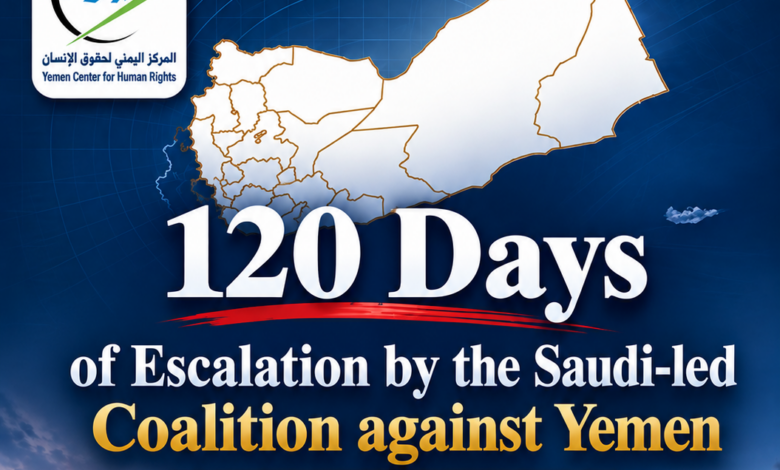
On Wednesday, 2 Jumada Al Thani 1448 AH (11 November 2026 AD), Yemen Center for Human Rights issued a human rights documentation report entitled ‘120 Days of Escalation by the Saudi-led Coalition against Yemen‘. Covering the period from 13 July to 10 November 2026, the report provides a statistical, human rights, and legal account of the most significant crimes, violations, and attacks recorded in several Yemeni governorates during the period of escalation. It also mentions the resulting loss of life among civilians and the damage caused to civilian objects and facilities.
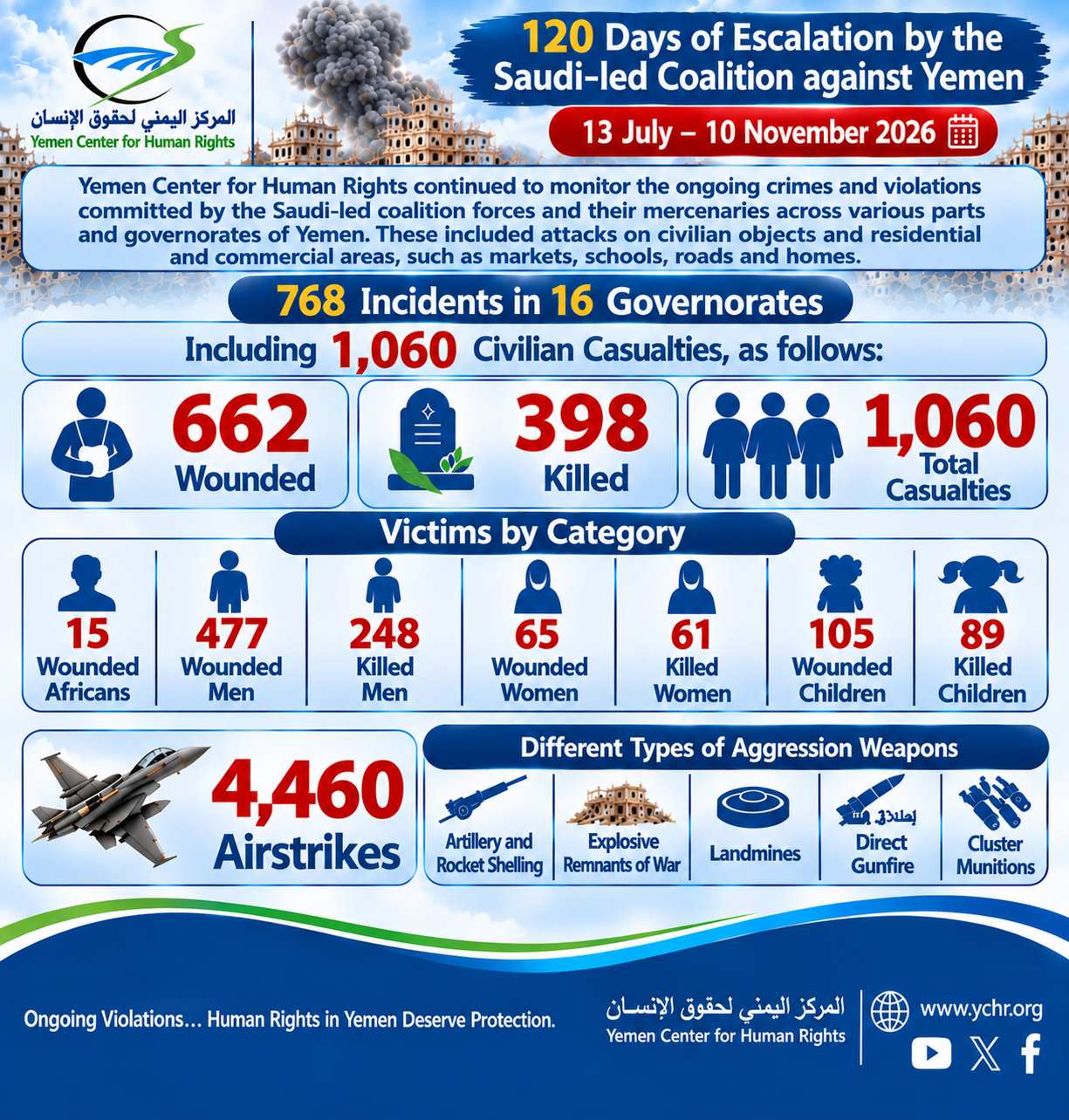
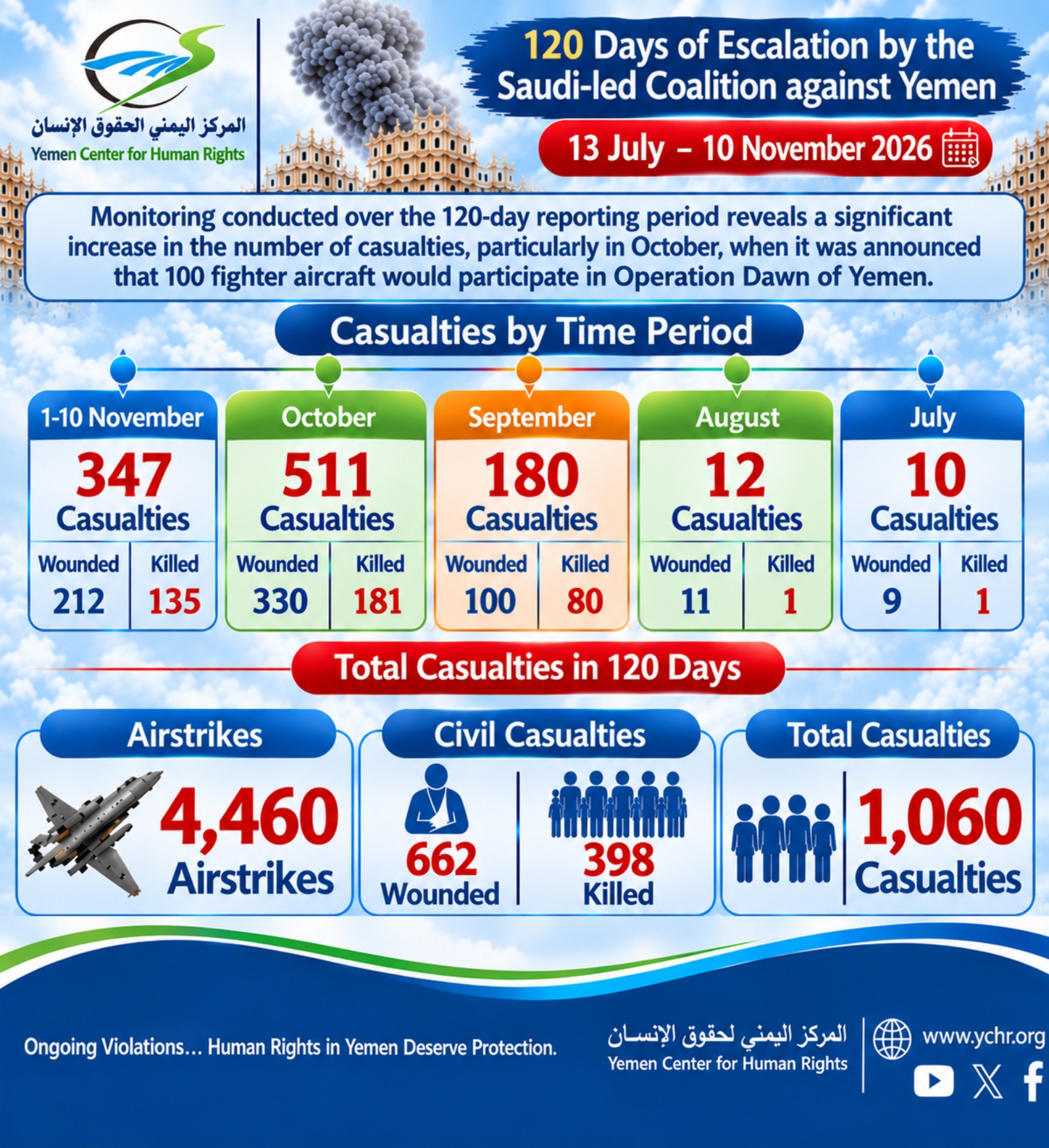
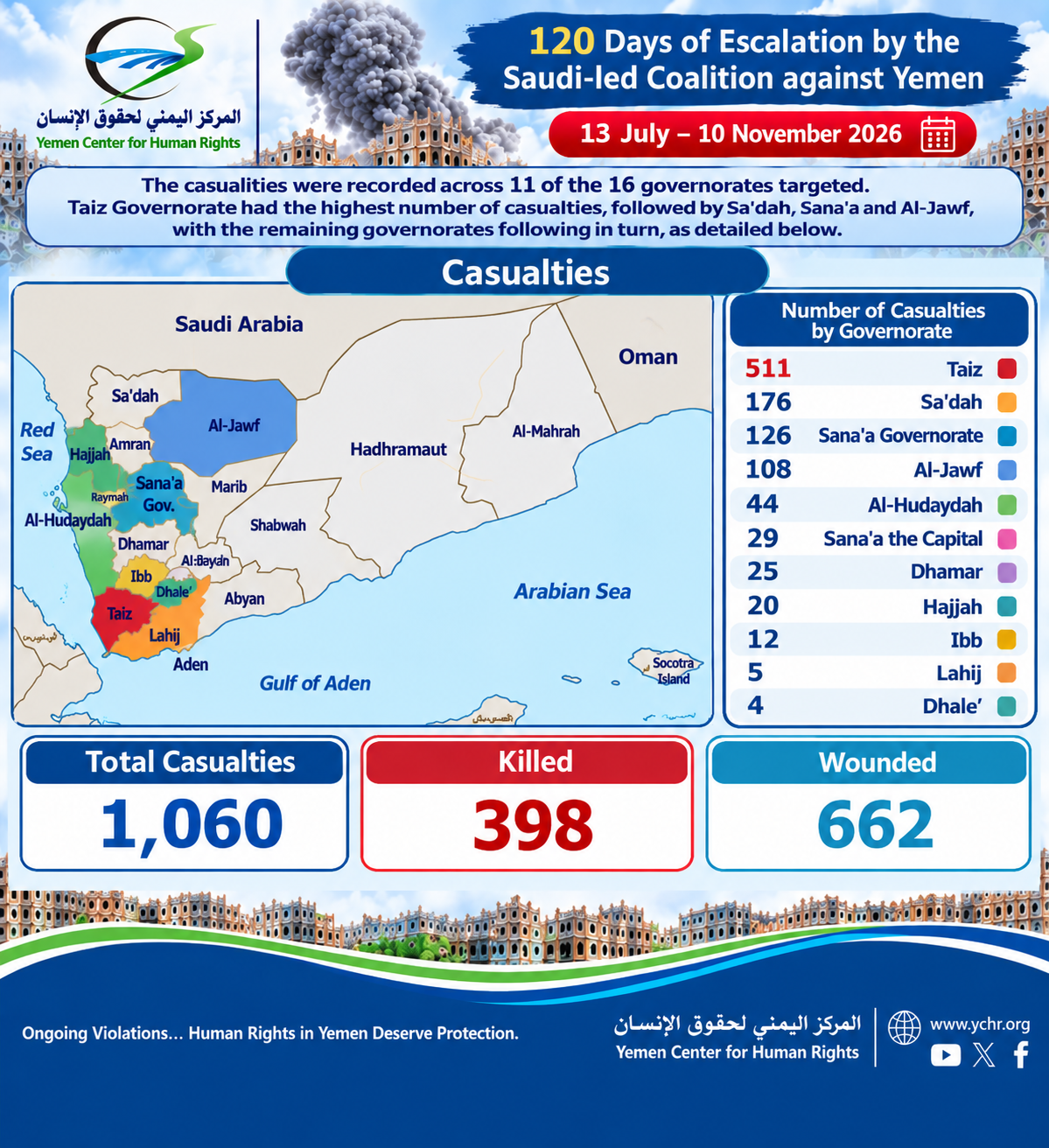
The report stated that the monitoring and documentation operations carried out by the Centre recorded 768 incidents across 16 Yemeni governorates. These incidents resulted in 1,060 civilian casualties, including 398 killed individuals and 662 wounded individuals. Of those killed, 89 were children and 61 were women, while those wounded included 105 children and 65 women, as well as 15 wounded Africans. The report also documented 4,460 airstrikes, alongside other forms of targeting, including artillery and rocket shelling, direct gunfire, and incidents involving explosive remnants of war, landmines, and cluster munitions.
The report also provided a detailed account of 12 crimes and incidents of human rights and legal significance, including attacks on local markets, homes, population centres, and civilian facilities; attacks on prisons, the Central Correctional Facility, and mosques; incidents involving the targeting of paramedics and humanitarian workers; the closure of roads and main crossing points; and other incidents that require investigation and accountability. The report further examined the legal characterisation of these incidents in the light of the rules of international humanitarian law and international human rights law. It concluded with a series of findings, recommendations, and demands concerning the protection of civilians, accountability for those responsible, and reparation for the harm suffered by victims.
In a statement marking the release of the report, the Head of the Yemen Centre for Human Rights, Ambassador Esmail Mohammed Al-Mutawakel, affirmed that these crimes and violations had been documented. He added that the Centre was working in cooperation with the judicial authorities to prepare the necessary case files for submission to the national courts. These efforts are aimed at pursuing those responsible for these crimes, along with their accomplices, through both national and international legal channels.
Mr Al-Mutawakel stressed that no future agreements or political settlements could deprive the Yemeni people of their right to hold the perpetrators accountable and seek justice against them in accordance with the law. He emphasised that victims’ rights cannot be extinguished by the passage of time or through political understandings, stressing that the pursuit of justice and accountability remains an inherent right that cannot be relinquished.
The Head of the Centre praised the role of the Ministry of Information and both state-owned and private media outlets in fulfilling their responsibilities to document these crimes and bring them to public attention. He called for stronger cooperation and coordination between the media, civil society organisations, and human rights bodies, in order to expand the scope of documentation, amplify the voices of victims, and expose the reality of what civilians in Yemen are enduring.
For his part, the Centre’s Executive Director, Ismail Abdullah Al-Khashib, explained that the report constitutes a human rights document and a record of the violations committed by the Saudi-led coalition against the Yemeni people. He added that it is based on daily monitoring carried out by the Centre’s Monitoring and Documentation Department and its team, using a database containing details of the incidents, their dates and geographical locations, the methods of targeting employed, the resulting casualties, and the associated damage.
Mr Al-Khashib noted that the Centre would issue weekly monitoring reports on the crimes and violations committed by the Saudi-led Coalition. These reports would document incidents as they occur in order to keep local and international communities regularly informed of developments in the escalation and its humanitarian and human rights implications.
He emphasised the importance of local and international human rights organisations fulfilling their responsibilities to monitor and document these crimes and violations in accordance with professional and legal standards. He also stressed the need for these organisations to issue detailed reports grounded in verified facts and documented data. Such efforts would contribute to securing redress for victims and strengthen the prospects of achieving justice and holding those responsible for the violations to account in the future.
The Centre concluded by reaffirming that the publication of this report forms part of its human rights and legal responsibilities to monitor and document violations, preserve facts and evidence, highlight the suffering of victims, and work to ensure that those responsible for crimes do not escape accountability. It renewed its call on international bodies and human rights and humanitarian organisations to fulfil their responsibilities towards protecting civilians in Yemen, securing redress for victims, pursuing justice, and providing reparation for the harm suffered.
Issued by
Yemen Center for Human Rights
2 Jumada Al Thani 1448 AH / 11 November 2026 AD